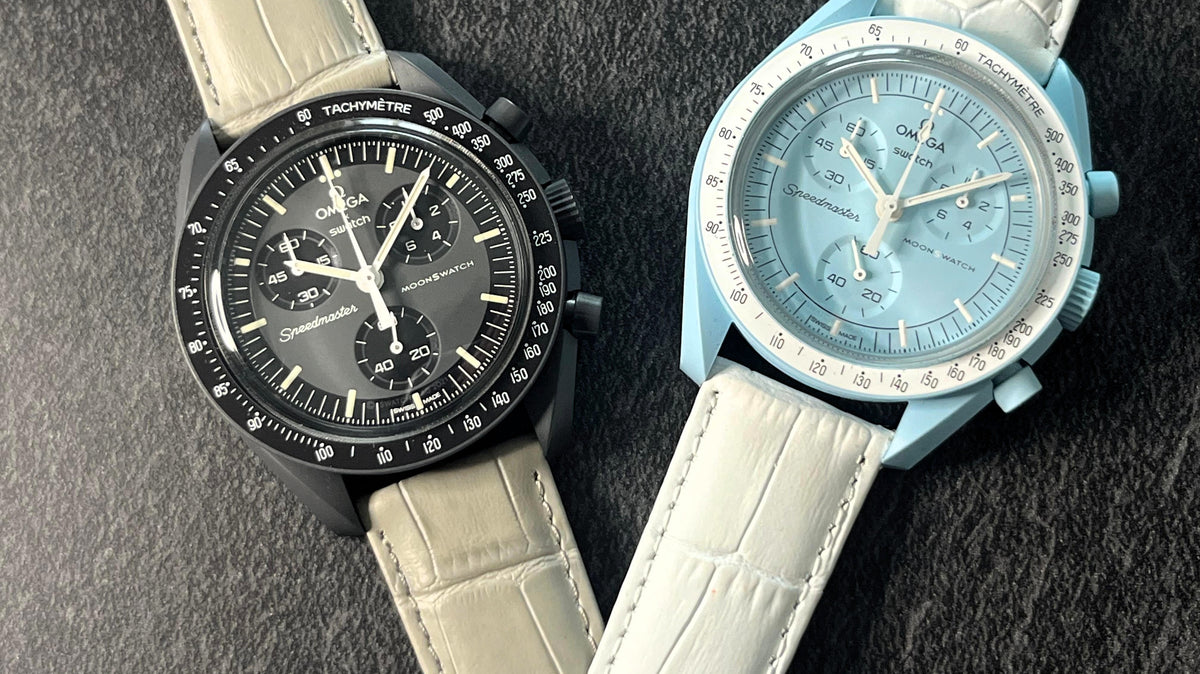
Replica watches look like a Rolex, Omega or Audemars Piguet and cost only a fraction of the price. Whether you may buy, bring back or resell them has no simple yes/no answer. Germany and Switzerland regulate the matter differently. In some holiday countries, even buyers have to pay a fine. This guide shows the legal situation as of September 2026, backed by the statutory texts and information from the customs authorities.
The key points in brief: Anyone who buys a replica watch purely for themselves is generally not committing a criminal offence in Germany. In Switzerland, private import is prohibited but expressly not punishable. In both countries, customs can still hold back and destroy a watch you ordered, and in Switzerland also a watch in your travel luggage.
- Germany: The Trade Mark Act only punishes acts "in the course of trade". Customs can still stop online orders from non-EU countries, even if you ordered privately.
- Switzerland: Since 2008, importing counterfeits is prohibited even for private purposes, but expressly not punishable (Art. 13 para. 2bis and Art. 65a MSchG).
- Reselling and offering is risky to criminal, even with the note "replica" in the listing.
- On holiday: In Italy, buyers face fines of 300 to 7,000 euros if the price, seller or quality point to a counterfeit. In France, even possession can be a criminal offence, and the customs fine is based on the value of the original.
What are replica watches? Replica, counterfeit and homage compared
Replica watches (also called "replicas" or "fake watches") are copies of well-known branded watches that adopt the name, logo and design of the original. If the watch bears someone else's brand, it is legally a trade mark counterfeit, no matter what the seller calls it. The term "replica" sounds more harmless, but it changes nothing about the legal situation.
Homage watches are different: they take their design cues from a well-known model but carry their own brand name. This is an important distinction: without someone else's name and logo, there is usually no trade mark counterfeit. However, the shape and design of a watch can also be protected.

| Term | Third-party brand on the watch? | Legal classification |
| Replica / Fake | Yes (name, logo, crown) | Trade mark counterfeit |
| Counterfeit | Yes, often with forged papers | Trade mark counterfeit, in some cases fraud if sold as an original |
| Homage | No, own brand | Usually not a trade mark counterfeit; design protection, shape marks and competition law may apply |
| Original | Yes, from the manufacturer | Legal |
Why replica watches are in demand anyway is obvious: a genuine luxury watch costs several thousand euros or francs, while a replica often costs only a two- or three-digit amount. Added to this is the status associated with well-known brands. However, anyone who opts for a replica only gets the look, not the quality. Depending on the country, you may also run into legal problems.
Are replica watches legal? The legal situation at a glance
The table summarises how the countries most relevant to readers in Germany and Switzerland deal with counterfeits. The penalty ranges are statutory maximums for trading, not typical penalties in individual cases.
|
Country |
Consequences for private buyers |
Penalty range for trading (maximum) |
|
Germany |
Generally not punishable, but customs can stop postal items |
Up to 3 years or a fine; if commercial, 3 months to 5 years |
|
Switzerland |
Not punishable, but private import is prohibited |
Up to 1 year or a fine; if commercial, up to 5 years |
|
Austria |
Not punishable under the Trade Mark Protection Act; customs can stop postal items as in Germany |
Fine of up to 360 daily rates; if commercial, up to 2 years |
|
Fine of 300 to 7,000 euros (administrative penalty) if the price, seller or quality point to a counterfeit |
Import for profit: 1 to 4 years |
|
|
France |
Possession without a legitimate reason can be punishable; customs fine of one to two times the value of the original goods |
Import or manufacture for sale: up to 4 years and 400,000 euros; organised or online: up to 7 years |
|
Not a criminal offence, but local fines are possible, for example in Barcelona |
1 to 4 years (manufacture, import) |
|
|
Not punishable; customs can seize counterfeits; exception for 1 item per type of goods only for certain brands |
Up to 10 years and/or USD 2 million (first offenders) |
|
|
United Kingdom |
Seizure possible; according to the British government, prosecution is also possible |
Up to 10 years |
Legal situation in Germany
Purchase and possession for personal use
The German Trade Mark Act (§ 14 MarkenG) only prohibits the use of third-party trade marks "in the course of trade". The penal provision in § 143 MarkenG also requires commercial activity. Anyone who buys and owns a replica watch purely for private use is therefore generally not committing a criminal offence. The Lower Saxony Consumer Advice Centre puts it this way: "Under German law, it is not prohibited to acquire trade mark counterfeits for purely private needs."
Not being punishable does not mean being free of consequences, however. The trade mark is infringed by the seller who sells and ships the watch. This is exactly where customs steps in.
Online orders from abroad: what customs does
A large share of counterfeits arrives by post from Asia: of all seizures by German customs in 2025, a good half involved postal traffic, and almost two thirds concerned goods from China. This is where many buyers go wrong: even if you order privately, the seller acts commercially. German customs states that "even when purchasing a single counterfeit item that you acquire for private purposes, there is a commercial transaction if it is ordered from an online shop". For you as the buyer, this generally means no criminal liability, but customs can stop the shipment.
The European Court of Justice confirmed this in 2014 in the case Blomqvist (C-98/13): a Dane had ordered a counterfeit Rolex from a Chinese online shop. According to the ECJ, the trade mark owner can claim customs protection simply because of the sale to a private individual in the EU.
This is how it works in practice, based on EU Regulation 608/2013:
- Customs stops the shipment and informs you as the recipient.
- You can agree to or object to the destruction. If you do not respond within 10 working days, customs may treat this as consent.
- If you object, the trade mark owner must have a court determine whether it is a counterfeit.
According to customs, the trade mark owner bears the costs of the small consignments procedure. The consumer advice centre warns, however, that storage and destruction costs may still fall on you under certain circumstances. If there are signs of resale, the consumer advice centre says cease-and-desist letters from the rights holders may also follow. The money for the watch is, as a rule, gone.
Bringing a replica back from holiday
An exception applies to travel luggage: according to Art. 1 para. 4 of EU Regulation 608/2013, it does not apply to "goods of a non-commercial nature contained in travellers' personal luggage". For such goods, customs does not intervene under the rules on industrial property protection. In terms of trade mark law, a single watch for personal use therefore generally goes unchallenged.
The exception ceases to apply as soon as the type and quantity of the goods, your person or other circumstances point to commercial activity. Customs then checks the goods for trade mark infringements and can seize them. Important: the exception only applies to luggage. If you send the watch home by post, you are back in the normal postal procedure. And it is not automatically duty-free either: from non-EU countries, goods up to 300 euros remain free of charges, up to 430 euros for air and sea travel, and up to 175 euros for travellers under 15. Above that, import duties apply.
Reselling replicas: classified ads, eBay, flea markets
Selling is where it gets tricky. Whether a sale already counts as acting in the course of trade is decided case by case. The ECJ looks at whether sales go beyond the sphere of a private activity "because of their volume, frequency or other characteristics" (C-324/09, L'Oréal/eBay). The Federal Court of Justice lists, among other indicators of commercial activity, repeated offers of the same kind, goods bought shortly beforehand and many ratings.
Consumer advocates therefore clearly advise against it. A note such as "replica" or "not genuine goods" in the listing does not automatically protect against a trade mark infringement. In 2002, in the case Arsenal (C-206/01), the European Court of Justice ruled that a notice at the sales stand stating that the goods are unofficial changes nothing: anyone who sees the goods later could still attribute the sign to the trade mark owner.
Penalties for traders
Anyone who trades in counterfeit watches in the course of trade risks, under § 143 MarkenG, a prison sentence of up to three years or a fine. For commercial acts or as a member of a gang, it is three months to five years. Even the attempt is punishable. In addition, there are civil-law claims by the trade mark owners for injunctive relief and damages.
Legal situation in Switzerland
Private import: prohibited, but not punishable
Switzerland is stricter than Germany. Since 1 July 2008, according to Art. 13 para. 2bis of the Trade Mark Protection Act (MSchG), the trade mark owner can also take action against the import, export and transit of counterfeits "if the import, export or transit of commercially produced goods takes place for private purposes". This applies to an online order just as much as to a watch in your suitcase.
However, this is not punishable. Art. 65a MSchG states verbatim: "Acts under Article 13 paragraph 2bis are not punishable." The Federal Office for Customs and Border Security (FOCBS) also confirms this. The consequence is civil-law: at the request of the trade mark owner, customs can hold back the watch. It is destroyed if you agree or do not expressly object. The trade mark owner can also take civil action against you.
New procedure for small consignments since July 2025
Since 1 July 2025, the Swiss Federal Institute of Intellectual Property (IPI) has been conducting the procedures for small consignments. A small consignment is a parcel of at most three units and under 5 kg, i.e. exactly the typical replica order. According to the IPI, these procedures do not apply to goods that customs finds in travel luggage. If the trade mark owner has applied for it, a simplified procedure applies (Art. 72i MSchG):
- You are informed of the suspicion and have 10 working days to expressly object to the destruction.
- If you agree or do not respond, the watch is destroyed. The trade mark owner bears the costs of this and cannot then claim damages from you.
- If you object, the case goes to the trade mark owner, who can take legal action. This then involves cost and litigation risks, up to a claim for damages.
Offering and selling: punishable
Anyone who offers, sells or stores counterfeit watches for sale infringes trade mark law under Art. 61 MSchG. The basic offence is punished, on complaint, with a prison sentence of up to one year or a fine. Commercial activity is prosecuted ex officio, with a prison sentence of up to five years or a fine. According to the IPI, the upper limit of the fine is then CHF 540,000 (180 daily penalty units of at most CHF 3,000). This is a theoretical maximum, not a typical penalty. The platform Stop Piracy expressly warns: "even if you offer a counterfeit as a private individual, you are committing a criminal offence."
Replica watches on holiday: where buyers pay too
The watch stall on the beach or at the market is a classic. It is worth a look at the local law here, because in some holiday countries buyers are affected too.
- Italy: End buyers who purchase goods whose quality, seller or price point to a counterfeit risk a fine of 300 to 7,000 euros (administrative penalty; the minimum amount was raised from 100 to 300 euros by Law No. 206/2023). The goods are confiscated (Art. 1 para. 7 D.L. 35/2005).
- France: According to the French administration, anyone carrying a counterfeit during a customs check commits an offence. A fine of between one and two times the value of the genuine goods is then due. The yardstick is therefore the price of the original, not that of the counterfeit. In addition, up to 3 years' imprisonment and a fine of 300,000 euros are possible; Art. L716-10 of the Code de la propriété intellectuelle names the same range for possessing a counterfeit "without a legitimate reason". In practice, the goods are confiscated. For travellers, a settlement with customs is mainly provided for in cases of minor infringements. A newly numbered Code des douanes has applied since 1 May 2026.
- Spain: Under the Criminal Code, only those who act "for industrial or commercial purposes" are liable to prosecution. However, municipal rules can also affect buyers; in Barcelona, for example, there is a fine of 100 to 600 euros for buying from unlicensed street vendors.
- USA: Trading is punished severely. US customs can seize and forfeit counterfeits (19 CFR 133.21). An exception of, as a rule, one item per type of goods every 30 days exists for travellers only for brands of US owners that are registered with US customs (19 CFR 148.55). If a watch imported this way is sold within a year, it or its value can be forfeited.
For the journey home, the law of your country of residence applies again: in Switzerland, import is prohibited even in luggage; in Germany, customs generally does not intervene under trade mark law for a single watch for personal use.
How many counterfeit watches customs finds
Counterfeits are not a fringe phenomenon. A few current figures:
- Germany 2025: According to its statistics on industrial property protection, customs recorded 19,124 seizures on suspicion of infringement of intellectual property rights. The value of the seized goods was 445.8 million euros. The statistics do not give a separate figure for watches; they are included in the category "personal accessories" together with glasses, bags and jewellery.
- Switzerland 2025: The FOCBS reports 11,467 cases of commercial goods under "seized consignments", after 8,318 the previous year. In addition, there were 1,442 cases in passenger traffic. 86.4% of the small consignments came from China.
- Swiss watches worldwide: According to an OECD study supported by the IPI, watches accounted for 87% of worldwide seizures of counterfeits infringing Swiss intellectual property rights. Between 2020 and 2021, 52% of all seized counterfeit watches bore brands of Swiss rights holders.
Spotting replica watches: what to look for when buying
Anyone buying a used luxury watch wants one thing above all: no counterfeit at the price of an original. Specialist dealers such as watch.de and Chronext name these features, using Rolex as an example:
- Price and dealer: A strikingly low price from an unknown seller is a clear warning sign.
- Serial number and rehaut: On modern Rolex models, the inner ring (rehaut) is engraved with "ROLEX", not printed.
- Crown in the glass: On Rolex models from around 2002, a tiny crown is laser-etched into the glass at 6 o'clock, visible only in certain light. According to watch.de, fake laser crowns are often visible immediately. If the crown is missing on an older watch, that is no indication of a counterfeit.
- Dial: Untidy lettering, uneven spacing or crooked indices give away many copies.
- Papers: Warranty cards and certificates can also be forged. Papers alone prove nothing.
The most reliable method is an inspection of the movement by a watchmaker or specialist dealer. Individual features alone are not conclusive proof. You can read more about buying safely in our guide buying a used wristwatch.
Fake shops: when nothing arrives instead of the watch
Besides the legal question, there is a very practical risk: many shops that offer branded watches at a fraction of the price deliver nothing at all, or something completely different. Getting your money back is then often difficult, especially after prepayment. Typical warning signs:
- Watches under model names of well-known brands at prices far below the usual market price
- A legal notice (imprint) without a company name, without a responsible person and without a commercial register or VAT number
- Missing, inappropriate or contradictory terms and conditions
- Prepayment as the only payment method
You can check whether a shop has already been reported as fraudulent in the list of fraudulent online shops on the Austrian platform Watchlist Internet.
Homage watches: the alternative without a third-party brand
Anyone who likes the look of a classic but does not want a counterfeit often ends up with a homage watch. It carries its own name and no third-party logo, so there is generally no trade mark counterfeit. Whether the model infringes rights anyway depends on whether its design is protected as a design or shape mark and how close it comes to the original. As a buyer for private use, you are not committing a criminal offence in Germany or Switzerland even then. However, a homage is not entirely risk-free: if it infringes a protected design, customs can, in Switzerland for example, hold it back even in the case of private import (Art. 9 para. 1bis Designs Act), and in Italy buyers too face a fine.
For manufacturers, though, the homage is no free pass. If a design comes too close to the original, design and competition law can apply. The best-known example is the Tchibo/Rolex case: in 1980, Tchibo sold almost 500,000 watches of the "Royal-Calendar" type for DM 39.95, which according to Rolex imitated the Datejust (men's model) and the Oyster Perpetual Date (women's model). Rolex was awarded damages: in 1984 the Federal Court of Justice confirmed the obligation in principle (I ZR 128/82) and in 1992 clarified how the amount is to be calculated (I ZR 107/90). In 2018, the Higher Regional Court of Frankfurt saw in an almost identical imitation of a watch model an unfair exploitation of reputation, "even [...] if the imitated model bears a different word mark" (Case No. 6 U 233/16).
Whether original or homage: a new strap often changes the character of a watch considerably. You will find matching straps for many well-known models in our category watch straps for branded watches. Which lug width your watch needs is shown in our guide to watch strap dimensions.
Other risks: quality and false warranties
Legal issues aside, replica watches often do not live up to what they promise visually. They often have simpler movements and workmanship defects, and accuracy and durability can suffer accordingly. There is no warranty from the brand manufacturer. Forged certificates and warranty cards are worthless and do not protect you in a dispute.
Conclusion: not punishable does not mean risk-free
Anyone who buys a replica watch purely for themselves is generally not committing a criminal offence in Germany; in Switzerland, private import is expressly not punishable. Nevertheless, the watch may be gone before it arrives: customs can stop online orders, and in Switzerland import is prohibited in principle. On holiday in Italy or France, buyers can also be held liable. Anyone who resells or offers replicas risks civil and criminal consequences, in Switzerland already when offering them. An honest note in the listing does not automatically protect against this. On top of that come quality defects and the risk of getting nothing at all from a fake shop.
The more honest solution is an original, used or new, or a homage watch with its own name. And if you want to give your watch a new look, a new strap from our range for branded watches is often enough.
Frequently asked questions about replica watches
Is buying replica watches a criminal offence in Germany?
Generally no. The Trade Mark Act only punishes acts in the course of trade (§ 143 MarkenG); buying for private use does not fall under it. For online orders from non-EU countries, however, customs can stop the watch and have it destroyed.
May I import a replica watch into Switzerland?
No. Since 2008, importing counterfeits has been prohibited even for private purposes (Art. 13 para. 2bis MSchG). Private import is, however, not punishable (Art. 65a MSchG). At the request of the trade mark owner, customs can hold back the watch and have it destroyed if you do not object.
What happens if customs finds my replica watch?
For an online order, you are informed and can agree to or object to the destruction. If you do not respond within 10 working days, the watch is generally destroyed. If you object, the trade mark owner can take legal action. As a rule, you do not get the purchase price back.
May I sell a replica watch on Kleinanzeigen or eBay?
This is clearly inadvisable. In Switzerland, even offering one is punishable. In Germany, a sale can count as acting in the course of trade, for example in the case of repeated offers of the same kind. Civil-law claims by the trade mark owner and a penalty under § 143 MarkenG then threaten. A note such as "replica" in the listing does not automatically protect you.
Can I bring a replica watch back from holiday?
When entering Germany, customs generally does not intervene under trade mark law for a single watch in luggage for personal use. If the type and quantity of the goods point to commercial activity, customs can seize them. Importing into Switzerland is prohibited even in luggage. In Italy, you risk a fine as early as the purchase. In France, possession can have criminal and customs consequences, and the customs fine is based on the value of the original.
Are homage watches legal?
As a rule, yes. Homage watches do not carry a third-party brand name or logo, so there is usually no trade mark counterfeit. As a private buyer, you are not committing a criminal offence in Germany or Switzerland. If the design of the original is protected, however, customs can still hold the watch back, for example in Switzerland. Manufacturers can get into trouble if the design comes too close to the original.
As of: September 2026. All information is provided without guarantee - despite careful research, no guarantee is given for up-to-dateness and completeness. The explanations serve only as general orientation and do not constitute individual legal advice. The legal situation can differ depending on the import route, country of origin, quantity, purpose and labelling of the goods. For specific questions, please contact a lawyer.